Sep 2014 – Jan 2015 Assignment@Design and Environment
Final mark: 66%
Research topic |
|
| Object : Urban regeneration User : Citizen in Seoul Context of use : Situation in South Korea Event/situation : Even though urban regeneration instead of redevelopment has become a verified method already in developed European countries, it is still the new term in South Korea. Inner city in Korea, degeneration is subject to be clean and constructed something new. Seoul has lost a lot of local context and history. Contemporary culture and society : It is associated with emerging countries in the coming future. |
|
Looking back imperfect restoration |
|
| Nine years ago, the restoration project of a stream which was covered with an asphalt road was finished. It was called a successful case of regeneration because there have been many positive effects economically and environmentally such as reduced air pollution and temperature, promoted tourism and new cultural places, established inter-urban recreational areas. However, when I saw the images that the Government of Seoul suggested, I felt a sense of difference, in line with the negative criticism from the people of all social standings. Originally, this stream didn’t flow down throughout the year. Since ancient times, it only flowed in the rainy summer. So, this restoration is artificial and not natural. In other words, to maintain the stream which now mechanically transports a huge amount of water from the Han River, the government has to spend nearly 4 million pounds per annum from taxes as the maintenance expenditure, as well as exhausting a huge amount of water from the river as a natural resource. In addition, the source of the stream was not restored as it is called a half-restoration and there are only 3rd class biological indicators were artificially planted; natural ecosystem was not restored and the remains of historical bridges were abandoned. In addition, the government did not resolve the conflict with existing retailers by just expelling them. The social critics point out the root of the problems as too short planning period which is reflective of the political stance of the mayor of those days, as well as a shallow research basis of waterfront regeneration which was merely benchmarked against the developed countries’ successful cases without deep consideration of cultural context and heritage. Thus, I don’t think it is a sustainable environmental development and I would rather call it a “half success” even though it is experiencing economic and social invigoration, unlike many people had predicted. For the past decade, critical opinions have gradually subsided and the positive effects are highlighted more strongly by the journals. However, it still calls for the aspiration of re-regeneration. | |
A raising issue as urban regeneration |
|
| The Seoul Highway, which has been raised as an issue recently, was completed in 1975 by the Park regime. It played a key part in the traffic operation of the surrounding area without traffic signals by traversing the rail road dividing west and east. Its daily volume of traffic is more than 50,000 vehicles. It is the only highway in this area. In regards to geographical analysis, the highway exists horizontally between east and west. It has taken charge of 82% of traffic volume in the near region and the retailers in the north-east have depended on the highway for supply and demand of goods. For the past 20 years, its responsibility was too great, until it was diagnosed as safety grade D which means there is a risk of collapse in 2006. Therefore, the straightforward solution was a new highway after demolition. As usual, the plan had not been advertised to the citizens because the policies for the city have many categories and are highly sophisticated. | |
The mayor of Seoul suggested it suddenly. |
|
 |
|
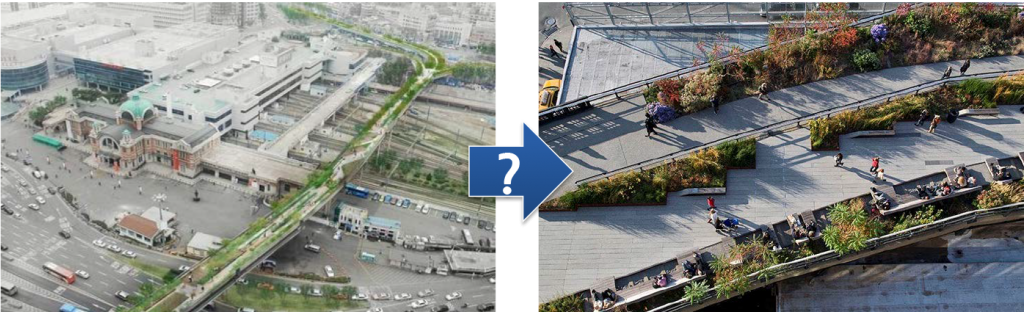
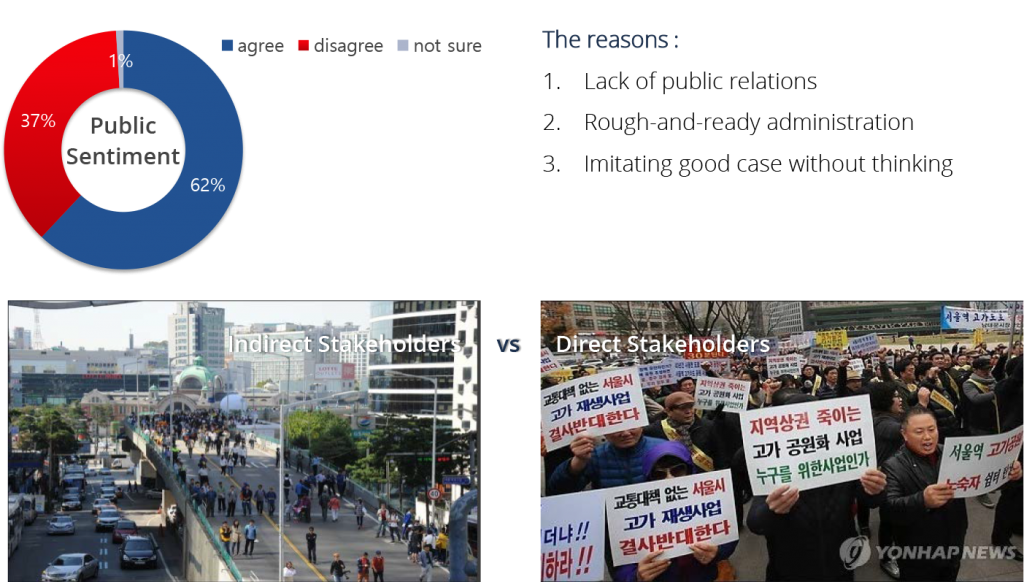
| However, a few months ago, the mayor of Seoul suddenly announced a sudden plan for the Seoul Highway which upset the existing plan after a business trip in New York. It was to be akin to the New York Highline Park. Many people welcomed this change because there will be another green space in the center of the city. They are the indirect stakeholders. However, the retailers thought differently from them because they are direct stakeholders. In addition, some opinion surveys indicate this phenomenon clearly; 62% of participants agree, 37% of respondents disagree and 1% of participants were not sure after asking 5963 unspecified persons in a day. The recent mayor of Seoul is from the progressive party but the past mayor who completed the Cheonggye-Cheon restoration was from the conservative party. His style of governance until nowadays was really simple and humble. It is ironic because it is likely to be different from his good policies for weak societies. A conservative media addressed this project by criticizing it; saying that he would use it as a bold achievement for the next presidential election. Of course, retailers from the adjacent area are deadly opposing it because they think that it will affect their business district. Pessimistic opinions include the retailers said that it is a still living highway, rough-and-ready administration, and just imitating a successful case without thinking of the context or any ramifications. Additionally they said that the plan without alternative solutions ignore the negative impact which affect the surrounding area directly and constitute a hasty decision. | |
Citizens are broke in two. |
|
|
|
Comparing the two |
|
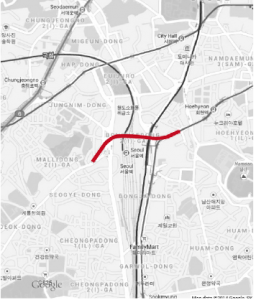
| Seoul central train station highway: 1. W: 10.3m H: 17m, L: 938m 2. Live Highway 3. Concrete structure 4. Announced by the government |
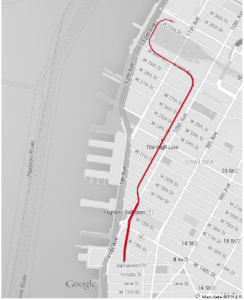
New York High-line: 1. W: 9.1m~18.3m H: 9m L: 2.5km 2. Abandoned for 20 years 3. Steel structure 4. Started from private section(aware citizens) 5. Took 10 years for completing |
| Shapes | |
 |
 |
Expanding to the urban highways in Seoul |
|
| More interesting facts about highways in Seoul can be found. There are 85 places, with a total length of 76km (2014.05) overpasses, but those were included in a policy where most of those were planned to be demolished for better landscape, catering for tourism. I think it is open to dispute that the highways spoil the urban cityscape, because, when I visited Tokyo, their highways were not ugly. This was because of their tall piers and shape of those structure. Even except for these facts, I think the flyovers are the components of, and the live pieces of evidence for the city. Actually, in the inner cities of Europe, for example, London and Paris, it is difficult to find any overpasses. However, this is not feasible. Thus, we should seek the new ways to resolve conflicts without rough-and-ready administration. Additionally, we should cultivate the divine identity of Seoul, rather than imitating defined European policy. There are other arguments, for instance, those which can have a negative impact on the natural environment; for example the effect of thermogenesis from asphalt in the harsh summer climate. Moreover, a concern of urban becoming a slum under a highway, that is to say, decreasing the quality of life. In Seoul, the property value of under-flyover areas is generally low. | |
Conclusion
In conclusion, I think there is no doubt that switching a degraded industrial heritage to a sky park is a great idea. BIAN Lanchun, a professor of Tsinghua University said Seoul is an impressive metropolis with green open spaces when he visited in 2013. Seoul, as a grown city, has expanded green spaces so far than in the past decade which people from Korea were concerned about because of rough-and-ready administration; such as the Cheonggye-Cheon project. Of course, it is a distinct privilege to have an exciting hanging garden for the citizens of Seoul. However, the character of Seoul is different from New York and even other metro cities. For example, many historical cities were established on flat land, but Seoul was formed on a hilly region as well as there are a lot of mountains in Korea. Those two cities have nothing in common except for their leveled up features. Therefore, to avoid making a rash decision, policymakers, urban designers, and municipal administrators should approach to it in a multidisciplinary way. Moreover, the retailers of the adjacent area must be mentioned. They are now threatened by the sudden policy alteration. The policy and budget proposal were hastily passed without social agreement from either private sector or the public. A few weeks ago, a discussion and negotiation was held in Seoul, where there was some reasoning discourse. Even a progressive journal which supported the Mayor continuously started to criticize him, stating that he has changed as the past Mayor who is a former president Lee elected by the success of the Cheonggye-Cheon project. However, like the Cheonggye-Cheon project, Korean society is now at a crossroad. During a decade, the city has grown up at a very rapid rate and the citizenship has reached a maturity more than in the past. In my opinion, I agree with the proposal, but even though the supporters of the new policy said that the highway park will be a hub to connect the many historical spots, I wish the Mayor will have a long-range view for the whole public, then he will probably win on election of the new president or be well-known as a good Mayor in the future.
Reflection on my work
Finally, during my research, I ask some critics to interview with a few questions below in Seoul, but they were reluctant to talk about it because their political stance.
Questionnaires:
1.Nowadays, Korea attempts to follow the European policy that verified as a successful action for urban regeneration. How do you think about urban regeneration in Korean context?
2.It is likely to be considered the urban regeneration as a right solution after the ‘trial and errors’ of urban development, redevelopment, city maintenance, and new town policy. How do you think about it?
3.What is the most important thing of reinvigoration of a city?
4.There might be a point of view that citizens’ participation is a key part of regeneration. How much helpful is the citizens’ involvement not the professionals? Might be there is negative influence or limitation?
5.Do you agree that the issue of Seoul Highway Park is positive?
6.The direct stakeholders; the merchants on near business area are objecting strongly. How do you think about it?
7.I think it is a somewhat delicate topic for the Mayor, but it seems that there is a similarity between the issue and Cheonggye-Cheon project. Thus, there is a lot of concern that new policy for the Seoul Highway would be a half-regeneration. In addition, it is too rushed because the political stance of the Mayor. How do you think about it?
8.Any other opinion, please.
The merchants of the business area who are objective on the new policy avoided an interview with filmmaking as well. When I started to make a film, I realized that it requires a professionalism in the investigation of the site. In other words, it was a bit different from site surveying in an architectural design procedure. When I activated a film editing program (Adobe Premier CC) after a 13-year hiatus, I was slightly in confusion, but I managed to edit the source films I prepared in person. It was the exciting experience with my compact camera with video capability. From now on, I will research based on the theories from Methods and Processes for the new modules except for a practical module.