Jan 2015 – Mar 2015 Assignment@Design and Ecologies
Final mark: 69%
Introduction
Since the invention of Post-it™ Notes, it has dominated our everyday life at an office and home as a convenient and
intuitive stationery for short messages. It is trivial, but very useful object to convey a short message, visualise a flow of idea or concept when people are doing brain storming and bookmark an important part of a book. While the
start of it was accidental and had a small influence, nowadays, it is a ubiquitous object to operate in our everyday
life. In addition, as Post-it™ had become one of the 120 pieces of the everyday items for “Humble Masterpieces”
exhibition in MoMA from April 8 to Sept 2004, according to Michael (2006, p. 95), it consolidated its system that
circulate within modern society intervening between communication as a mundane artefact. In this portfolio, I will
identify its system then suggest an intervention to improve it sustainably.
The history of Post-it™ Note
“Post-it™ was born more than 30 years ago as an adhesive note that fulfills the roles of a reminder, a notepad or a
to-do list, eliminating the mental distraction stirred up by thinking about an unfinished idea or a pending activity;
poetically speaking, Post-it frees the human mind. With the purpose of highlighting the space where it is placed, its
colors are bright; in addition, they can be stuck and unstuck to any surface several times.” Espindola, C. (2014)

Post-it™ Notes and modern society
Nowadays, sticky notes known as Post-it™ Notes exists everywhere as an item conveys small messages or organising tools at the moment of brainstorming. This simple trivial object has influenced on our communication. Michael (2006, p. 95) mentioned an interesting perspective that using Post-it™ Notes can be kept on a tight rein immediately and expanded their meaning in metaphorical ways. In other word, it intervenes certain position of things and potential hierarchy itself. Thus, it is able to operate in a very special power play even though it camouflage its intrinsic attribute under the simple function and appearance. For example, in a democratic horizontal brainstorming, the members of a group make ideas then, a person can attain a slight high position which can organise the words by order regarded as important or not.

Mapping system
The term ‘system’ (‘System’, 2015) had developed in the natural science, especially in thermodynamics, in 19th
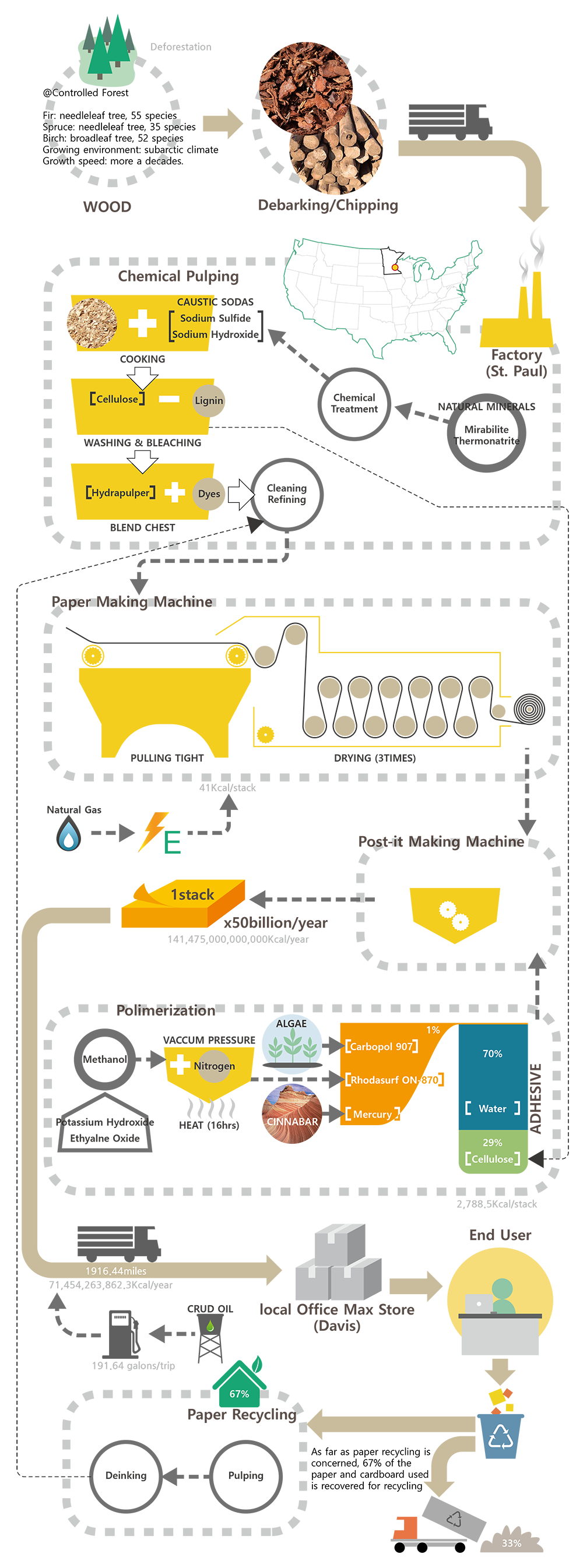
century. Although the theories which derived from it are various and extensive over whole society, there is a simple example of the structure of its concept. It is compounded of several parts or members namely input, output, processor, control, feedback, boundary and interface, and the environment. In addition, there are several types of system; Physical or abstract systems, Open or closed systems and ‘Man-made’ information systems; that help understanding system structure which operates a certain department. I think that the elements of a system as an example are able to help identify the Post-it™ Notes system. However, it can be identified through the Life Cycle of a Post-it Note (University of California Department of Design, Course Blog, 2014).
Thinking Alternatives
1. Raw Materials
Even though more than a half amount of used paper is recycled, paper making industries spend the large number of wood logs. Thus, deforestation is still the big environmental issue on the Earth. Among the endeavours to solve that problem, we need to focus on a paper maker brand called ‘Double A’ (Paper-Tree for a Better Life, 2011). They are producing paper in a sustainable way that the local farmers cultivates 400 million trees for selling to the company near manufacture site. According to the website, the growth of the paper-trees takes just 4 years as compared with normal trees which take more than a decade for paper making. In other words, if they apply the way mentioned above, deforestation problem can be solved in a simple way and they can manufacture virgin paper without degradation occurs in recycling. In addition, expenditure of transporting can be remarkably reduced.

2. Energy
From the fact that company uses a lot of fossil fuel, it might be considered to convert into renewable energy namely tidal, wind, solar and nuclear power. However, because of the Shale Oil Revolution, oil price is declining so far (Cunningham, 2014). In the future, fossil fuel like oil might be promoted to use in the industrial area. Thus, research and intention for renewable energy is likely to be slower than so far because it will last for many hundreds of years. Although that geopolitical circumstance, I think alternative energy is very vital for the clean environment. Thus, 3M had better convert to renewable energy in the future.

Closing the loop
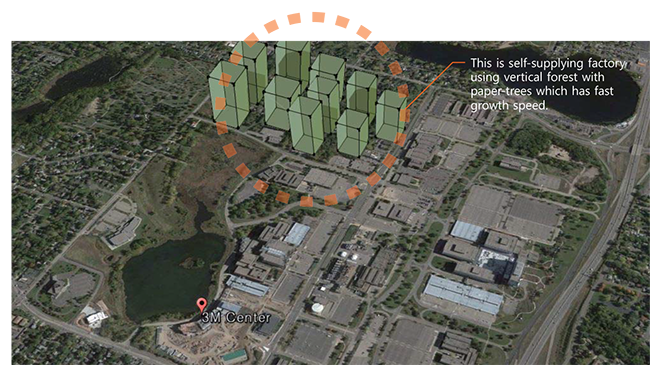
The concept of vertical planting started from MVRDV who is leading architects group for EXPO pavilion, 2000. They suggested this kind of farming concept then nowadays it has become a very popular architectural concept. However, because of the limitation of technology, it is difficult to be realized except for temporary structure like that of MVRDV. Although in Milano, a residential tower named ‘Bosco Verticale’ (2015) with this concept has been built, it might be slightly different with vertical forest because it looks like terrace with the large plant pots. Nevertheless, it can be a good start.


Bibliography
‘Bosco Verticale’ (2015) Wikipedia. Available at: http://en.wikipedia.org/wiki/Bosco_Verticale (Accessed: 21 February 2015).
Cunningham, N. (2014) How Long Can The Shale Revolution Last?. Available at: http://oilprice.com/Energy/Energy-General/How-Long-Can-The-Shale-Revolution-Last.html (Accessed: 24 Fab 2015).
Espindola, C. (2014) ‘Case Study: 3M listens to ideas on how to use the Post-it’, Joe Kutchera, 18 December. Available at: http://joekutchera.com/case-study-3m-listens-to-ideas-on-how-to-use-the-post-it/ (21 February 2015).
Michael, M. (2006) Technoscience and everyday life. Open University Press.
Paper-Tree for a Better Life (2011) Available at: http://csr.doubleapaper.com/en/khanna_farmer.asp (Accessed: 20 Fab 2015).
Silver, S. (2013) ‘The ‘hallelujah moment’ behind the invention of the Post-it note’. Interview with Spence Silver and Art Fry. Interview by Nick Glass and Tim Hume for CNN.COM, 4 April.
‘System’ (2015) Wikipedia. Available at: https://en.wikipedia.org/wiki/System (Accessed: 21 February 2015).
University of California Department of Design, Course Blog. (2014) ‘Design History Course’, Design Life-Cycle: Energy, Materials and Design Across Time. Available at: http://www.designlife-cycle.com/post-it-notes/ (12 Feb 2015).