Critical Reflection@Technical Studies 2_Making Session
Final mark: 78%
FROM NOTHING
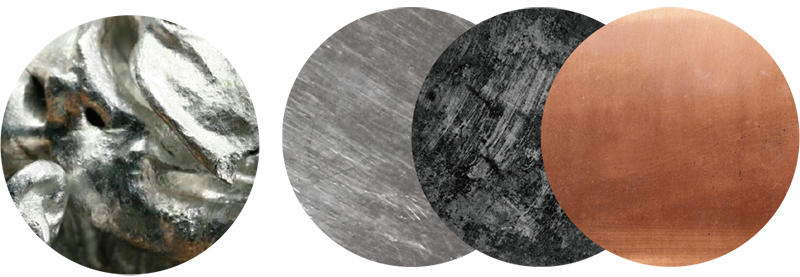
When I signed up to the making session of the Technical Studies 2 option, there were several materials for me to select from. I used to be familiar with using wooden materials including MDF, plywood, timber, etc., but I had been thinking that I would like to explore metal craft more as I find it very attractive. When I was occupied in the professional field, woodwork was easy to approach but metalwork was an area that I had no experience in as it would be carried out externally by contract. Therefore, I made the decision to learn more about the world of metalwork. I considered this event as if I was entering my own Iron Age. There are a range of different metals. Fortunately, I knew to some extent the different characteristics of some metals such as aluminum, silver, steel, copper, etc. The word ‘Metal’ is likely to derive an image of iron or steel, but when the adjective ‘easy’ is added, I think many people would think of ‘aluminum’. As I thought that aluminum has a similar luster to silver and is very cheap as well as being used to make kitchen foil and cookware. It seemed that using small pieces of aluminum would be a good way of introducing myself to the world of metalwork.. I chose a 1mm thick aluminum sheet as a starter to work on at the session.. In this text, I will reflect on the procedures I followed to make an untitled object and the learning outcomes. Following this I will then make proposals for further action.
MAKING PROCEDURE
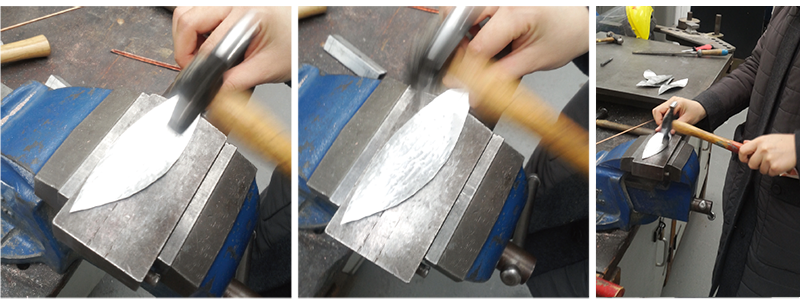
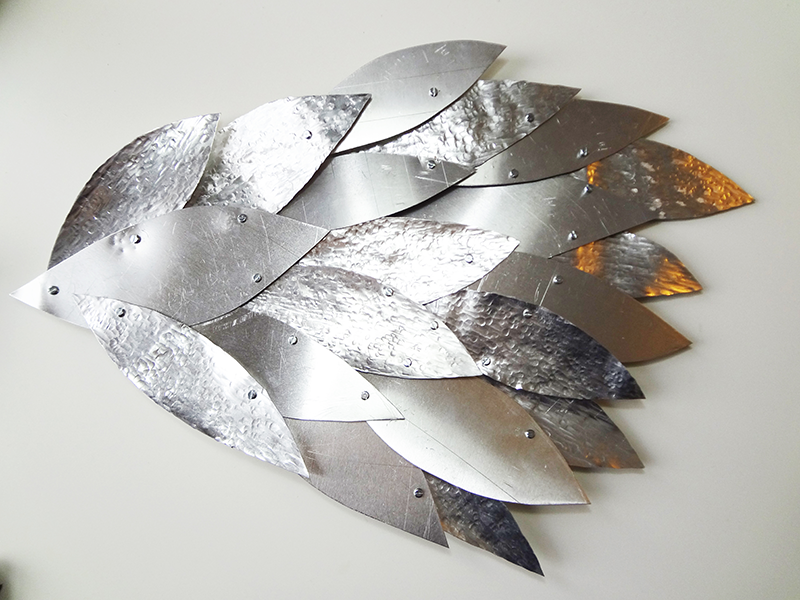
I was a little disconcerted when I got a 1mm thick aluminum sheet. It was stronger and duller than my expectations. I thought about the silver-like shine and flexibility of foil’s underside. But because it is a raw material, it is likely to depend more on my processing to reveal the final appearance. I was unsure what to do. I just sketched a wing with feathers. Its shape resembled flower petals. I did not really think about what it was to become. So, there was no way to know how it would be displayed. The making process had just started according to my first rough sketch. To begin, I transferred my drawing onto the bare aluminum sheet and cut each petal out using a big pair of scissors-like a machine. These tailored petals looked very flat and raw at first. Next, I gave texture to the petals by beating its surface with two different shaped-cap hammers. It required a lot of physical power to beat it. If I want to produce a very hand-crafted quality like texture, I would need to hammer the aluminum a lot. So, I decided to save half of the petals so that I could mix and match two different textures. In other words, I intended at least to demonstrate the mixture of the two surface feelings. Then I asked a tutor who specialized in metal work about which media to use to fixate each petal. I thought something similar to an adhesive would be appropriate but the tutor recommended fixing with small nuts and bolts as the metal petals were bent from the hammering. To assemble with nuts and bolts, a hole need to be drilled. After drilling, I was able to assemble these aluminum petals. I thought the final look was very beautiful and showed the machinery aesthetic because the nuts and bolts seemed to enhance the mood of the piece.
THINKING ABOUT EXPERIMENTAL METAL WORK
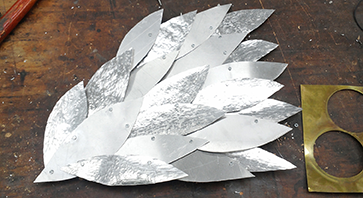
I dare call my final outcome an object without desire. Design is an intension and an intension arises from needs. However, my work was not an attempt of this, just a creation of an unknown force. I would rather call this an excretion of my unconscious. That unconscious was not demonstrated but it might be an expression of something. I think it can be a part of art, object, architecture and fashion. For example, it can be just an object that enhances the atmosphere of a residential space, decorative roof tiles or fashion accessories chosen to express a user’s intention. When it comes to the metal as a material, it could acquire imperishability in comparison to other materials. As if I had drawn this idea of eternity using the metal’s characteristics, my experimental work might escape from its materiality. That is to say, an object without desire has evolved as an art with immateriality. According to Paik, J. (2005) art is said to be an analogon [analɔgɔ̃] pursuing unreality and non-substantiality.
Learning outcome
Through this session, I could make a connection with metal work and acquired two main lessons. Firstly, I could develop basic skills and techniques for metal work. Also, I have come to really appreciate the value of metal craft works which require a lot of physical labor and time in order to create value. For example, I felt pain in my hand the next morning and it was not possible to create the desired texture in a short time. Secondly, I could also explore the information of metal further not only different types of metal but also different activities such as metal jewelry and metal detecting hobbies. In particular, metal detecting was a strange but interesting subject area for me because I was able to read posts of people who do this kind of activity on the Internet, and I came to realize that there is a lot of mania for this area throughout the world, even in my native country South Korea. Finally, even though what I gained was a very fundamental skill and knowledge level, I still think it was a meaningful step in this area of design.
CONCLUSION AND FURTHER ACTION
To sum up, my choice to participate in the making session was really helpful in my steps to learn more about the metal craft. This procedure was finished in two days but it was exceedingly hard and time-consuming work: If we value an objects existence it might require a lot of labor and time to produce. Also, I could understand about the true metal materiality through handling it directly. After the workshop, I had the opportunity to develop a hypothetical concept of my final work as a piece of artwork. Finally, I have two plans for further development concerned with this technical option. 1. I will read a book entitled ‘STEEL: A design, cultural and ecological history’ by Tony Fry which seems to be not only related this subject but also to the ‘Design and Ecology’ option.. 2. I would like to try to work with silver as an advanced skill of metal work in the coming weeks.
REFERENCES
‘Aluminum’ (2015) Wikipedia. Available at: https://en.wikipedia.org/wiki/Aluminium (Accessed: 29 August 2015).
‘Metal detector’ (2015) Wikipedia. Available at: https://en.wikipedia.org/wiki/Metal_detector (Accessed: 29 August 2015).
Paik, J. (2005) Gogh’s shoes(빈센트의 구두, Reading contemporary philosophy through the paintings). Seoul: Kiparang(기파랑). in Korean